
Pieces for Solo Piano
Whispers of the Orient (Opus 1)
For more information and the inspiration behind this opus, check here
1. Nocturne in D-flat major “Moonlight”
‘Moonlight’ is a piece for solo piano that celebrates both the Mid-Autumn Festival and the calm, transcendent powers of the moon’s beauty. It is inspired by the famous Tang dynasty poem, ‘Gazing at the Moon, Longing from Afar’ composed by Zhang Jiuling, and fuses both Eastern and Western musical influences, in particular Chopin, Liszt and Debussy’s ‘Clair de Lune’.
Incorporating a Chinese children’s song <<月亮婆婆出来了>> (Grandmother Moon has Emerged) floating above a flowing bassline, the opening segment depicts a poet who, in a pavilion far from his home, gazes at the moon by the weeping willows and lapping waters of a lake, recalling tender days of childhood innocence and memories of loved ones. Dark, swirling clouds threaten to veil the moon, but the moon emerges in victorious radiance. As the poet struggles with troubled memories, villagers in a distance send off firecrackers that fall like a shower of stars. The sounds of revellers recede and are soon forgotten, as the poet continues his reverie beneath the moon’s glowing orb.
2. The Floating World
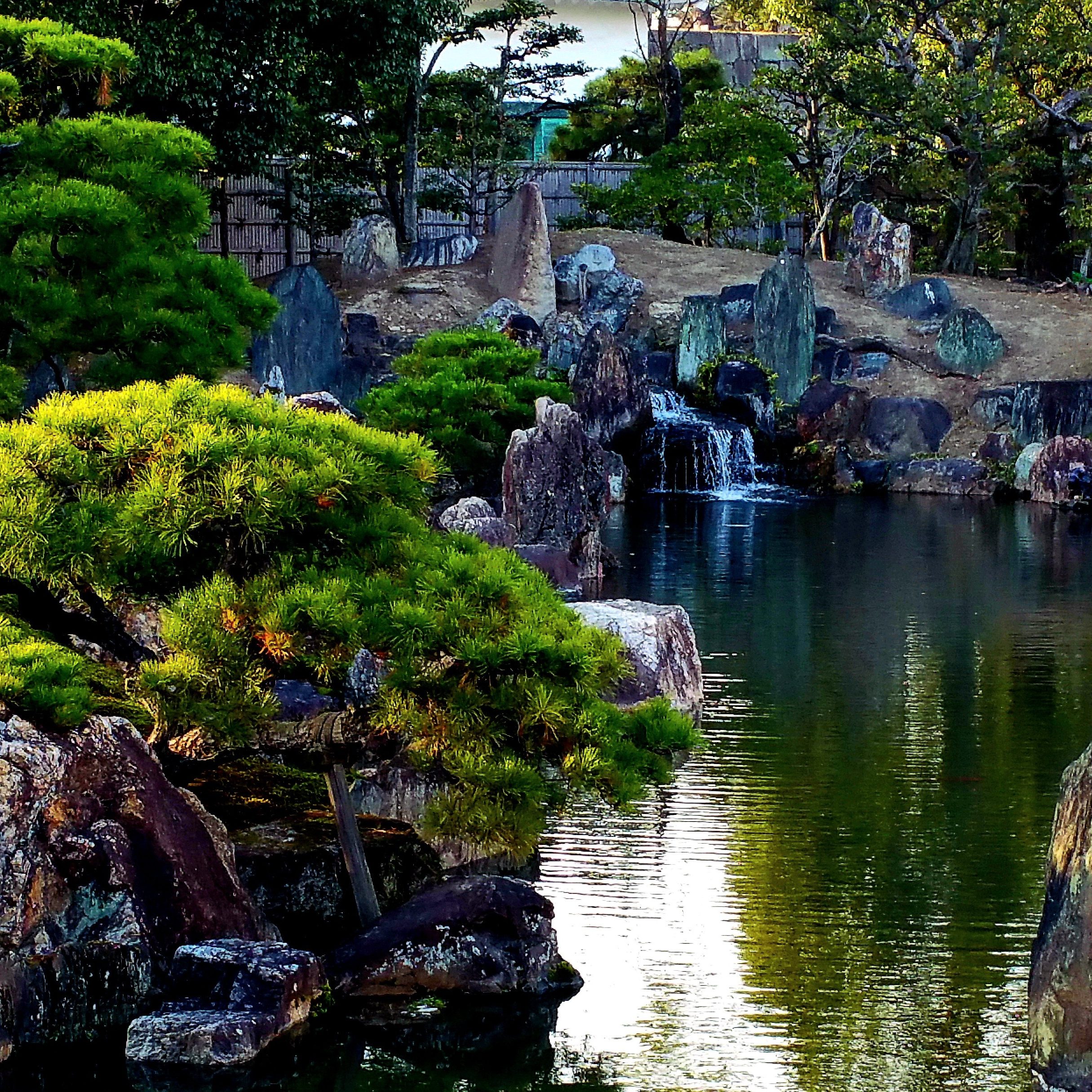
‘Ukiyo-e’ (pictures of the floating world) draws its name and inspiration from the famous Japanese woodblock prints, particularly the landscape prints of Hokusai and Hiroshige. This short piece for piano aims to recreate the contemplative atmosphere in these delicate depictions of the natural world and provide a space to reflect on the transience of earthly things. I have attempted to achieve this mainly through the use of a simple motif that repeatedly ‘floats’ in high tessitura. The piece also showcases influences from Joe Hisaishi and the In pentatonic scale used in traditional Japanese music, most notably the folk song ‘Sakura’.
3. Caprice in G-flat major
‘Fish Pond’ aims to evoke both boisterousness and tranquility, as the piece imagines a boy in the Qing dynasty feeding his carp fish which thrash and swim excitedly in the small pond of his family courtyard. As he feeds the fish, he daydreams that he is rowing a boat across a sparkling lake blooming with lotus flowers. His idle thoughts bring him as far as the great Yellow River, where he sees the fabled carp swimming persistently up a cascading waterfall, striving to be transformed into a mighty dragon.
4. Spring Song
This short piece for piano showcases Chinese musical influences, aesthetics and philosophy. It is subdued and reflective, an ode to the gentle awakening of Nature at the start of Spring. The program behind this song without words is as follows:
A millennium ago, in the Song dynasty, a scholar returns to his home village on a solitary path. Drawn by the sound of a flowing stream, he enters a bamboo forest where bright shafts of sunlight pierce through the foliage and birds perch, calling to each other on the bamboo tops. Where winter snow once hung, now white flowers unfurl their petals on leafless branches. Breathing in the fresh air and seeing the delicate beauty of this hidden grove, the scholar delights in a rare glimpse of earth and heaven in harmony.
Piano Prayers
1. Fantasia on a Taize Hymn “O Lord, Hear My Prayer”
The music of the Taize community is known for its simplicity and repetitive nature, encouraging its listeners to meditate on the teachings of God. The inherent minimalism thus opens many opportunities for improvisation and variation, as shown by this fantasia which grows organically from a simple melody (original melody composed by Jacques Berthier).
2. Agnus Dei
To celebrate the Passion, my musical offering is a piano arrangement of a song I wrote which sets the texts of John 1:29 (“Behold the Lamb of God…”) and Revelation 5:12 (“Worthy is the Lamb…”) to music. The discovery that both verses could be adapted comfortably to the melody was a happy occasion for me. The first verse is in the warm key of B-flat major, tenderly reflecting on the innocence of the Lamb, whilst the second verse is set in the majestic, bright key of C major, glorifying the triumph of Christ.
3. Gregorian Rhapsody
This piece for piano was inspired by a lovely Gregorian chant that I heard while watching the Vatican Christmas Mass last year. Although this chant melody is set to the prayer ‘Kyrie Eleison’, my pianistic interpretation makes use of its major key to focus more on the gladness and joy when receiving God’s mercy rather than the antecedent sorrow of penitence.
Other Instrumental Music
Chamber Ensemble
1. Sicilienne, for Flute and Strings
Following the characteristics of the traditional dance, this sicilienne composed for flute and string orchestra incorporates lilting compound rhythms and a minor key. It is, however, particularly moody and aims to depict some faraway isle with rugged and mossy cliffs, lashed with cold dark waves and lost to the chronicles of History.
2. Love Divine, for Oboe, Flute and Strings
‘Love Divine’ is the famous hymn written by Charles Wesley in the 18th century, celebrating the glory and beauty of sacred Love. Although it has been sung to several tunes, in this video, I have created my own melody for the hymn and I have orchestrated it for the oboe, flute and string quartet.
3. Little Fugue, for Flute, Violin and Piano
‘Little Fugue’ is an exercise in Baroque compositional and contrapuntal techniques, produced from a hopeless desire to learn the unsurpassable style of Bach. Short motives, transposed and inverted in various forms, are passed between all four voices in an imitative polyphonic framework constantly propelled forwards by pulsating motor rhythms.
4. Piano Quintet “Ancient Legend”
‘Ancient Legend’ is a short piece for piano quintet. It is conceived as programmatic music except, unlike Berlioz’s Symphonie Fantastique, the precise narrative underpinning the piece will not be so explicitly outlined. However, it is hoped that with the reverential opening section, the unsettled middle section and the jubilant ending, it would not be difficult for the audience to imagine a backstory where the boundary between myth and history is blurred.
5. Sinfonia in D minor
Duets
1. Passacaglia, for Violin and Piano
‘Passacaglia for Violin and Piano’ revolves around a chromatically descending base ostinato, which offers many variational possibilities. Written in the Romantic style, the piece passes through brooding melancholy, rapid spirited passages and tender Chopinesque interweaving melodies, constantly propelled by its unyielding harmonic structure towards an exhilarating finale. It also achieves these effects by employing the violin’s large palette of techniques and tone colours, including pizzicato, spiccato, the warm sul G tone, rolled 4-string arpeggiations, double stops, contrasts in dynamics and ornamental flourishes.
 Isaac Tang - Poet, Author, Composer